What is padel?
The fastest-growing racket sport in the world: where it came from, how it differs from tennis, and why it spreads so quickly.
Updated 4 September 2026
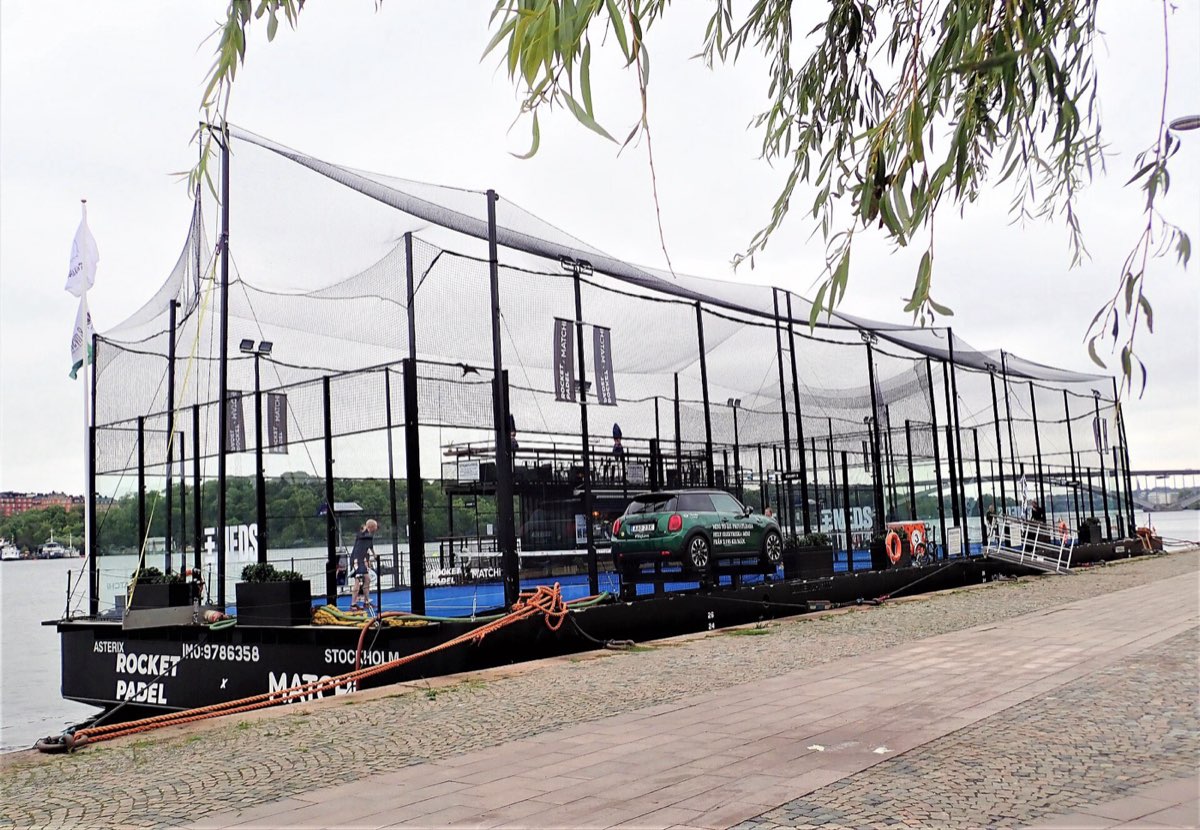
The short version
Padel is a racket sport played by two pairs on a 20 by 10 metre court enclosed in glass and mesh. The racket is perforated and frameless; the ball looks like a tennis ball but carries slightly less pressure.
It is almost never played singles. The court is too wide for one person to cover and exactly right for two.
What makes it different: the walls
The walls are the one feature that separates padel from tennis and from squash. After the ball bounces it comes off the glass and stays in play, so a shot that would end a tennis point is the middle of a rally here.
Two things follow. Rallies last, which means a beginner gets to play rather than to fetch. And power alone doesn't win: a ball struck hard comes back off the wall and can hand your opponent an easy one.
Court, net and kit
The court is 20 by 10 metres, roughly a third of a tennis court. The net stands 92 centimetres at the posts and 88 in the middle, dipping slightly in the centre as in tennis.
The back walls are three metres of glass with a metre of mesh above them. The side walls are stepped, dropping as they approach the net. That step is the most technical part of the court, not a detail of construction: it decides the angle a ball leaves the glass at, and a ball off the side wall is far harder to read than one off the back.
The ball resembles a tennis ball but is pressurised a little lower, so it bounces less. A tennis ball works, but it stays too lively and the rebounds off the glass become unpredictable — which is why clubs hand out padel balls.
The racket is solid, perforated and short-handled. The rules allow a maximum of 45.5 cm in length, 26 cm in width and 38 mm in thickness. The wrist strap is compulsory: there are three other people on the court when a racket leaves your hand.
How a match runs
Scoring is counted as in tennis: 15, 30, 40, game. Six games make a set, two sets make a match, and 6–6 goes to a tiebreak.
The serve is underarm and struck cross-court. You bounce the ball once and hit it at or below waist height, with two attempts as in tennis. The serve rotates within the pair, and the serving side changes at the start of each game.
Amateur tournaments mostly ignore that structure: instead of sets they play a fixed time or a fixed number of points, and partners change every round. The Americano and Mexicano formats exist for exactly this.
A two-set match runs an hour to an hour and a half, which is also how long a club court is usually booked for.
Compared with tennis
Scoring is identical: 15, 30, 40, game. The game itself is not.
- The serve is underarm, struck at or below the waist — no overhead serve
- The court is about a third the size, so you cover far less ground
- The walls are in play; the ball comes off them and the point continues
- The racket is short-handled and stringless, which makes contact easier
Where it came from
The game began in Acapulco, Mexico, in 1969. Enrique Corcuera walled in a narrow space beside his house because there wasn't room for a tennis court; what came out of it was a different sport.
It took hold in Spain and Argentina and spread across Europe through the 2010s. In Spain it is now reckoned the most played sport after football.
Courts have multiplied quickly in Turkey over the past few years, though they remain concentrated in the larger cities.
Where it is played in Turkey
Court numbers are climbing fast but they are not spread evenly. The density is in Antalya, Istanbul and Izmir; some of the venues in Muğla run seasonally, and Ankara and Bursa still have only a handful of courts. The club directory on this site ranks more than a hundred clubs across six provinces by distance.
Courts are rented by the hour and the fee is usually split four ways. Most venues rent rackets too, so a first session needs no equipment at all. The one thing to bring is a flat-soled court shoe: running shoes do not support lateral movement, and most padel movement is lateral.
The real obstacle is not the court but the head count — you need four. Nearly every club runs a WhatsApp group and missing players get filled from there. For a beginner, turning up at a club and joining the group works far faster than asking around.
Padel clubs by city: Antalya · İstanbul · İzmir · Muğla · Ankara · Bursa
Why it spreads so fast
The learning curve is shallow. You can rally on day one, where tennis takes weeks to reach the same point. The walls forgive mistakes and the short racket makes the ball easy to meet.
It's a sociable game: it needs four people and the court is small enough that everyone can hear each other. Nobody goes alone.
The physical demand is moderate too. The court is small and rallies are long but the running is short, so people of different ages and fitness can share a court.
Frequently asked questions
- Is padel easier than tennis?
- It is easier to start. The short racket makes the ball easy to meet, the walls forgive mistakes, and you can rally on day one — tennis takes weeks to reach the same point. Getting good is not easy: the bandeja, the wall exit and positional play are specific to padel, and a tennis background helps little with any of them.
- Do I need to play tennis first?
- No. Tennis helps for the first couple of hours because you are used to striking a ball, but after that some tennis habits — the hard overhead and the long swing in particular — turn into things you have to unlearn.
- How big is a padel court?
- 20 by 10 metres, about a third of a tennis court. The back walls are three metres of glass topped by a metre of mesh, and the side walls step down as they approach the net.
- Can padel be played singles?
- Almost always it is doubles. A narrower singles court exists but is rare in Turkey, and on a standard court one player cannot cover the ground.
- What should I bring the first time?
- A flat-soled court shoe and water. Most clubs rent rackets and the venue supplies balls. Buying your own racket makes more sense after a few sessions, once you know what you like.
- How many people do I need?
- Four. If you are three, the club WhatsApp group will find a fourth; if you are on your own, most clubs point you towards open games. With more than five, the Americano format keeps everyone in rotation.