Padel court dimensions
From the 20×10 m playing area to the wall steps, net height, ceiling and door sizes: a padel court as the official rules define it.
Updated 12 September 2026
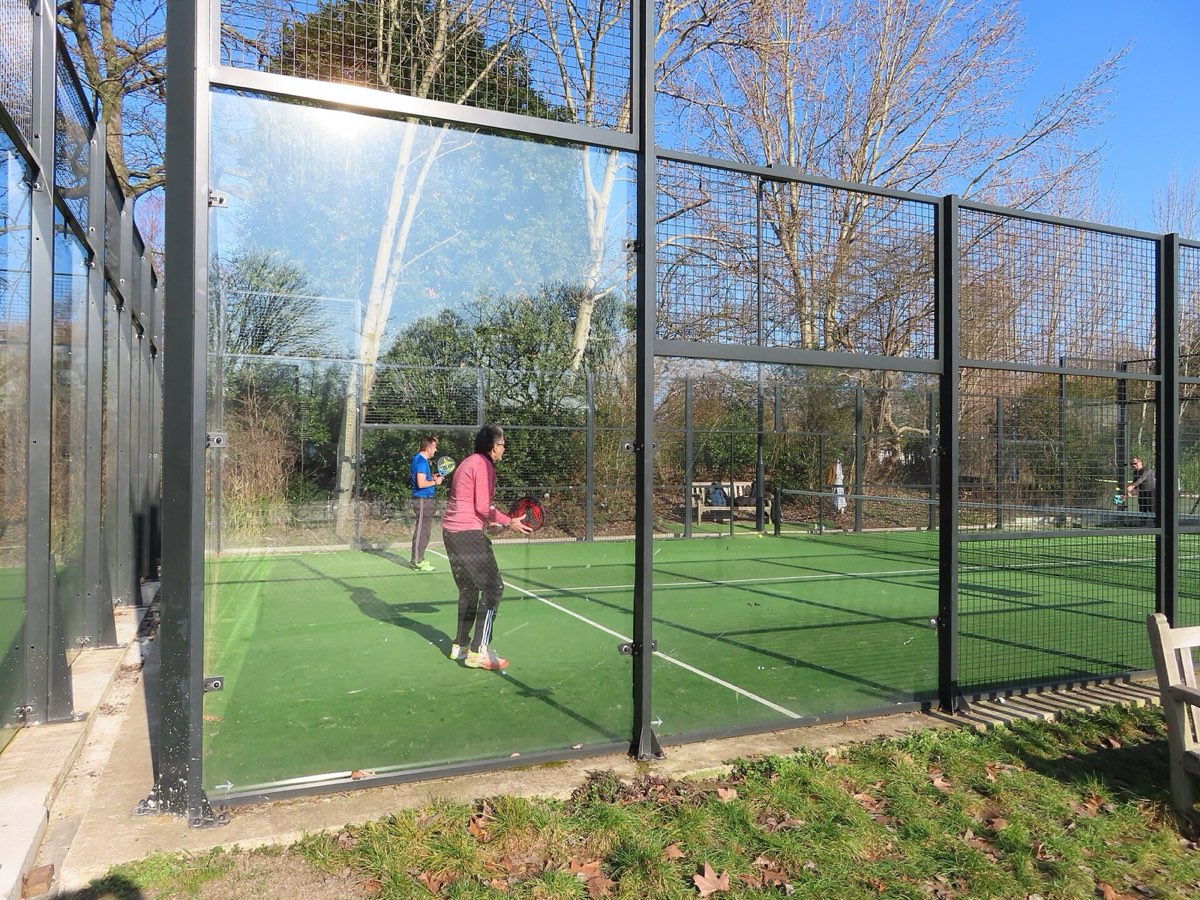
The short answer
Measured from the inside, a padel court's playing area is 20 metres long and 10 metres wide: 200 square metres. The International Padel Federation (FIP) rules allow a 0.5% tolerance on that.
Every measurement below comes from the FIP rulebook in force from 1 January 2026. Most club courts are built to it; recreational and mobile courts can differ slightly.
- Playing area: 20 × 10 m, inside measurement (200 m²)
- Back walls: 4 m in total — 3 m of wall with 1 m of mesh on top
- Net: 10 m long; 88 cm in the middle, 92 cm at the ends
- Service lines: 6.95 m from the net
- Line width: 5 cm
- Ceiling: at least 6 m clear, with 8 m recommended for new venues
Playing area and lines
The court is a rectangle split in half by the net. On each side, parallel to the net and 6.95 metres from it, is a service line. The area between the net and the service line is divided in two by a perpendicular centre service line, which runs at least 20 centimetres past the service line.
All lines are 5 centimetres wide and preferably white or black, so they stand out from the surface. The two halves must be exactly symmetrical in their line layout.
Unlike tennis, there are no tramlines and no separate baseline: the walls mark the edge of the court.
Net height
The net is 10 metres long, 0.88 metres high in the middle and 0.92 metres at the ends, with a tolerance of half a centimetre. The posts holding it are at most 1.05 metres tall.
A white band between 5 and 6.3 centimetres deep runs along the top of the net. The net has to fill the space between the posts with no gaps, but it shouldn't be taut.
Walls: back and sides
The court is fully enclosed. The back walls are 4 metres high in total: the first 3 metres are wall, glass or brick, and the last metre is metal mesh.
Wall surfaces must be hard, smooth and give the ball a consistent bounce everywhere, in a colour clearly different from the floor. Measured diagonally, the mesh openings are between 5 and 7.08 centimetres.
The rules allow two layouts for the sides:
- Stepped: at each end, a wall 3 m high and 2 m long, then a step 2 m high and 2 m long. Mesh brings the enclosure up to 3 m along the middle 6 metres and to 4 m at the ends.
- Unstepped (panoramic glass): at each end, a flat wall 3 m high and 4 m long. Over the last 2 metres at each end, mesh brings the height up to 4 m.
Surface
The surface can be concrete, a synthetic material or artificial grass, as long as the ball bounces evenly. Sand-filled artificial grass is the most common at clubs.
The permitted colours are green, blue and terracotta tones. The whole surface must be one colour, clearly different from the walls. Measured with a 3-metre straightedge, level differences must stay under 3 millimetres; on surfaces without drainage a slope of up to 1% from the centre to the edges is allowed.
Doors
Entrances sit in the side walls, symmetrical around the centre. There can be one or two on each side, with or without a door; if there is a door, the handle must be on the outside and not stick into the court.
- One entrance per side: at least 1.05 × 2.00 m, at most 2.20 × 2.20 m
- Two entrances per side: each at least 0.72 × 2.00 m, at most 1.10 × 2.20 m
Ceiling height and lighting
The whole court needs at least 6 metres of clear height, with nothing such as spotlights reaching into it. For new venues 8 metres is recommended; the lob is one of padel's basic shots and a low ceiling takes it out of the game.
Light poles stand outside the court, with the bottom of the floodlights at least 6 metres off the ground. The light must be even and must not dazzle the players. For TV broadcasts, at least 1,000 lux of vertical illumination is required.
For outdoor courts, the rules recommend running the long axis north–south, so the sun isn't constantly in one team's eyes.
How much space do you need?
The playing area is 200 square metres, but the court also needs room for the thickness of the walls and posts, plus a walkway around it. The total depends on the build; what the rules fix is the 20 × 10 metres inside.
If play outside the court is allowed — chasing the ball out after an x3 or x4 smash — each side needs a clear area in front of the entrances at least 3 metres wide (4 metres recommended), 4 metres long and 3 metres high.
Indoors, the real constraint is usually the ceiling rather than the floor area: a hall under 6 metres can't take a court built to the rules.
Compared with a tennis court
A tennis court's doubles lines measure 23.77 × 10.97 metres, so the two playing areas are close in size. The difference is the surround: a tennis court needs a wide run-off outside the lines, while a padel court ends at its walls.
That's why two to three padel courts can fit in the space of one tennis court, and why converting tennis courts to padel has become so common.
Frequently asked questions
- How many square metres is a padel court?
- The playing area is 200 square metres: 20 metres long by 10 metres wide, measured inside. Wall thickness and a walkway around the court come on top of that.
- Is a padel court a different size from a tennis court?
- Yes. A padel court is 20 × 10 metres; a tennis court's doubles area is 23.77 × 10.97 metres. Because a padel court is walled in, it doesn't need the wide run-off around it that tennis does.
- How high is a padel net?
- 88 centimetres in the middle and 92 at the ends. The net is 10 metres long and the posts are at most 1.05 metres tall.
- How high are the walls of a padel court?
- The back walls are 4 metres in total: 3 metres of glass or wall with 1 metre of mesh on top. On a stepped court the side walls drop from 3 to 2 metres at each end, and the mesh brings the height up to 3 metres in the middle and 4 metres at the ends.
- How high does the ceiling need to be for an indoor padel court?
- The rules require at least 6 metres of clear height over the whole court, and recommend 8 metres for new venues.
- What surface should a padel court have?
- Concrete, a synthetic material or artificial grass; all are within the rules as long as the ball bounces evenly. The colour should be a single shade of green, blue or terracotta.